


Why Coil Nails Matter More Than Most People Think
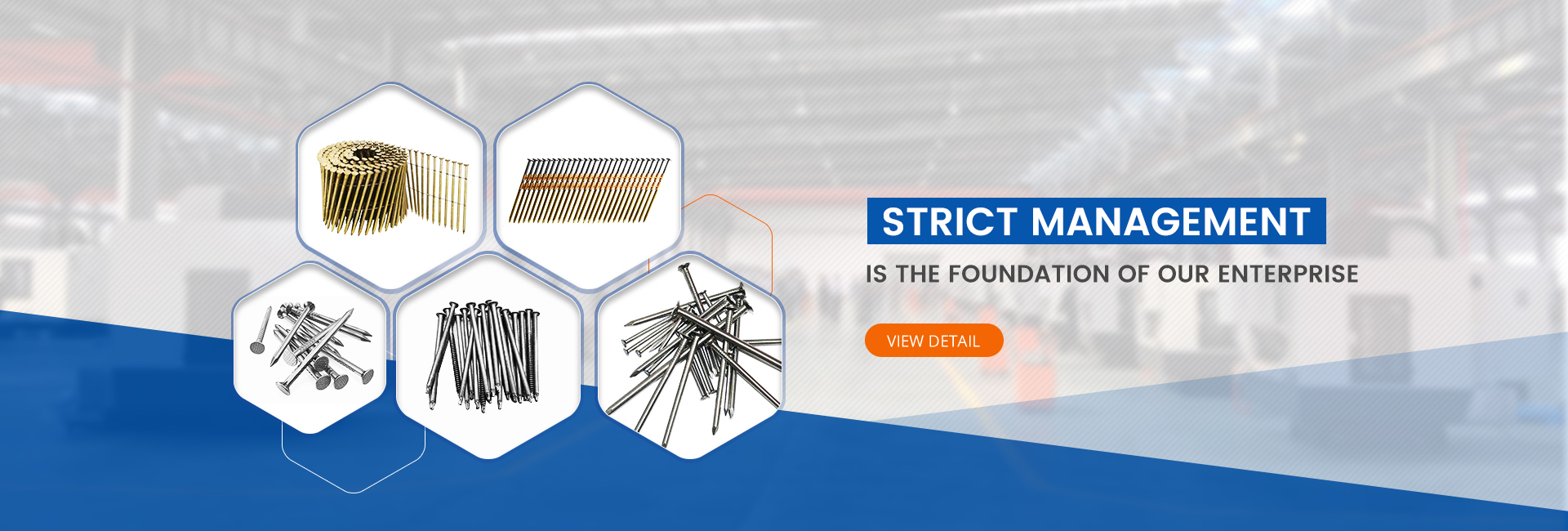
In industrial wood fastening, coil nails are often treated as a standard consumable—something chosen mainly by price and availability. In reality, coil nails sit at the intersection of material science, automation efficiency, and structural reliability.
For pallet manufacturers, packaging plants, and construction-related users, coil nails are not simply about fastening two pieces of wood together. They influence production rhythm, equipment stability, joint performance, and long-term cost control.
Understanding coil nails as a system component rather than a commodity is what separates high-efficiency operations from those constantly dealing with jams, rework, and inconsistent quality.
1. Mechanical Performance: Beyond Shear Strength
A nail’s job does not end once it is driven.
In real working conditions—especially pallets used in logistics—fasteners are exposed to:
Repeated vibration
-
Dynamic loads during stacking and transport
-
Humidity changes causing wood expansion and shrinkage
Well-designed coil nails optimize:
-
Shank geometry to interact with wood fibers instead of cutting them
-
Point design to reduce splitting while maintaining penetration efficiency
-
Surface treatment to balance corrosion resistance and friction behavior
This is why smooth, screw, and ring shank coil nails perform very differently—even when made from the same wire diameter.
2. Collation and Feeding Stability: The Hidden Cost Factor
In automated or semi-automated nailing lines, feeding consistency matters as much as nail strength.
Poor collation quality can lead to:
-
Misfeeds and nail jams
-
Increased downtime
-
Accelerated wear on nailers
-
Inconsistent drive depth
Professional coil nail production focuses on:
-
Precise collation angle control
-
Stable bonding material behavior (wire, plastic, or composite)
-
Uniform coil tension and diameter
These factors directly affect line efficiency and labor cost, even though they are rarely visible on a quotation sheet.
3. Manufacturing Consistency: Where Quality Is Really Decided
Two coil nails may look identical, yet behave very differently on the production floor.
Key variables include:
-
Wire drawing consistency
-
Heat treatment control
-
Thread or ring forming accuracy
-
Plating or coating uniformity
High-volume users quickly realize that nail consistency reduces downstream problems far more effectively than frequent equipment adjustments or operator intervention.
In this sense, coil nails are not a standalone product—they are a reflection of the manufacturer’s process control capability.
4. Application-Specific Selection: No “One Nail Fits All”
Using the same coil nail for all applications is often a compromise.
Different use cases demand different priorities:
-
Pallets: withdrawal resistance, vibration tolerance
-
Crating: holding power + controlled penetration
-
Outdoor construction: corrosion resistance and durability
-
High-speed lines: feeding stability above all
Choosing the right coil nail specification is not about upselling—it is about matching performance to real working conditions.
Conclusion: Coil Nails as a Long-Term Efficiency Tool
At scale, the real cost of coil nails is not the price per box—it is:
-
Downtime
-
Rework
-
Equipment wear
-
Structural failure risk
Professionals who understand this no longer ask “Which nail is cheaper?”
They ask “Which nail keeps my line running and my products reliable?”
That is where coil nails stop being consumables—and start becoming a strategic choice.

Post time: Dec-24-2025