

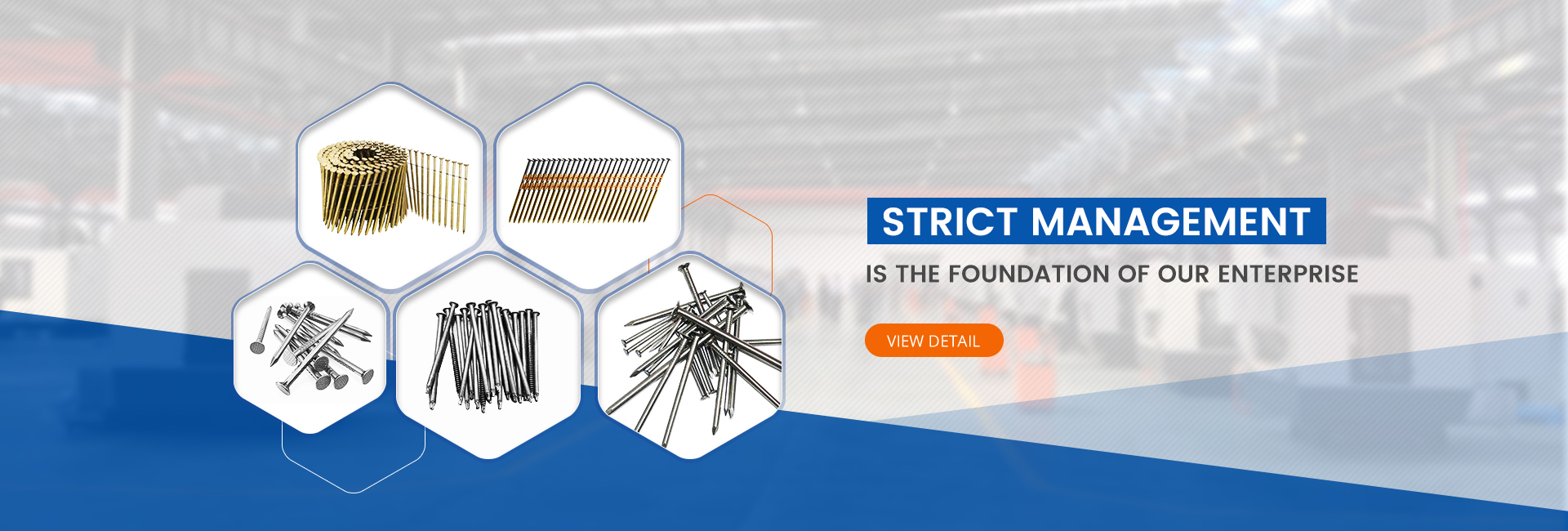
Large coil nails are widely used in pallet manufacturing, wooden packaging, construction and other applications where continuous nailing is required.
Compared with standard small coils, large coils can reduce the frequency of nail replacement and help improve production efficiency. This makes them particularly useful for high-volume and automated production.
But for customers who use coil nails every day, performance is about much more than diameter, length and surface finish.
It starts with the entire manufacturing process.
1. Nail dimensions are only the starting point
Basic specifications such as nail diameter, length, head size, point type, shank profile and surface treatment need to match the customer’s application and nailing equipment.
For example, 2.5 × 70 mm coil nails are commonly used in pallet production. But correct dimensions alone do not guarantee good performance.
Nail strength, point quality and forming consistency are equally important.
2. Welding quality affects feeding stability
Individual nails need to be welded together to form a continuous coil.
If the welding is inconsistent, the coil may break, separate or cause feeding problems during production.
The goal is not simply to make a strong weld. The weld should also be consistent and properly controlled, without excessive deformation that could interfere with feeding.
For automated nailing lines, consistency is often more important than how strong a single weld looks.
3. Consistent coiling matters
Another important factor is coil consistency.
Poor tension control during coiling can result in loose sections, uneven coil formation, misalignment or changes in feeding resistance.
These problems may not always be obvious during manual inspection, but they can become much more noticeable when the coil runs continuously through an automated nailing system.
A good large coil should not simply be “wound.”
It should be neatly wound, stable and consistent throughout the coil.
4. Nail points should not be overlooked
Different applications may require different nail points, such as standard points, diamond points, clinch points or skew points.
The point design can affect penetration and how the nail behaves inside the wood.
For pallet production in particular, wood species, moisture content and board thickness can all influence nailing performance.
So instead of specifying only “2.5 × 70 mm,” it is better to confirm the point type, shank profile, surface treatment and equipment requirements.
5. Surface treatment is more than appearance
Large coil nails can be supplied with different surface finishes, including bright finish, electro-galvanized and hot-dip galvanized coatings.
The appropriate finish depends on the actual working environment and corrosion-resistance requirements.
Indoor packaging applications and outdoor wooden structures may have very different requirements.
The right coating should therefore be selected based on actual application conditions, rather than simply choosing the thickest coating.
6. Nail quantity matters in high-volume production
For pallet manufacturers, the number of nails per coil and per carton directly affects production planning and purchasing efficiency.
Stable quantities make it easier to calculate:
nails per pallet → pallets per day → monthly nail consumption.
This is why professional buyers often look beyond the price per carton and consider the overall cost per nail, packaging efficiency and container loading quantity.
7. The real value is stable production
A coil nail that costs slightly less does not necessarily mean a lower overall production cost.
If the nails frequently cause:
jams → downtime → machine adjustment → coil replacement → restart
the cost of lost production can quickly exceed the initial saving.
That is why a good large coil nail should offer:
consistent dimensions + reliable welding + uniform coiling + smooth feeding + accurate quantity.
These are the details that matter in real production.
Conclusion
A large coil may look like nothing more than many small nails connected together.
But its performance depends on every step—from wire quality and nail forming to welding, coiling and final inspection.
For a coil nail supplier, making the coil is only the beginning.
The real measure of quality is whether the customer can put the coil on the machine and keep production running smoothly.
That is where the value of a large coil nail really comes from.
Post time: Sep-21-2026