

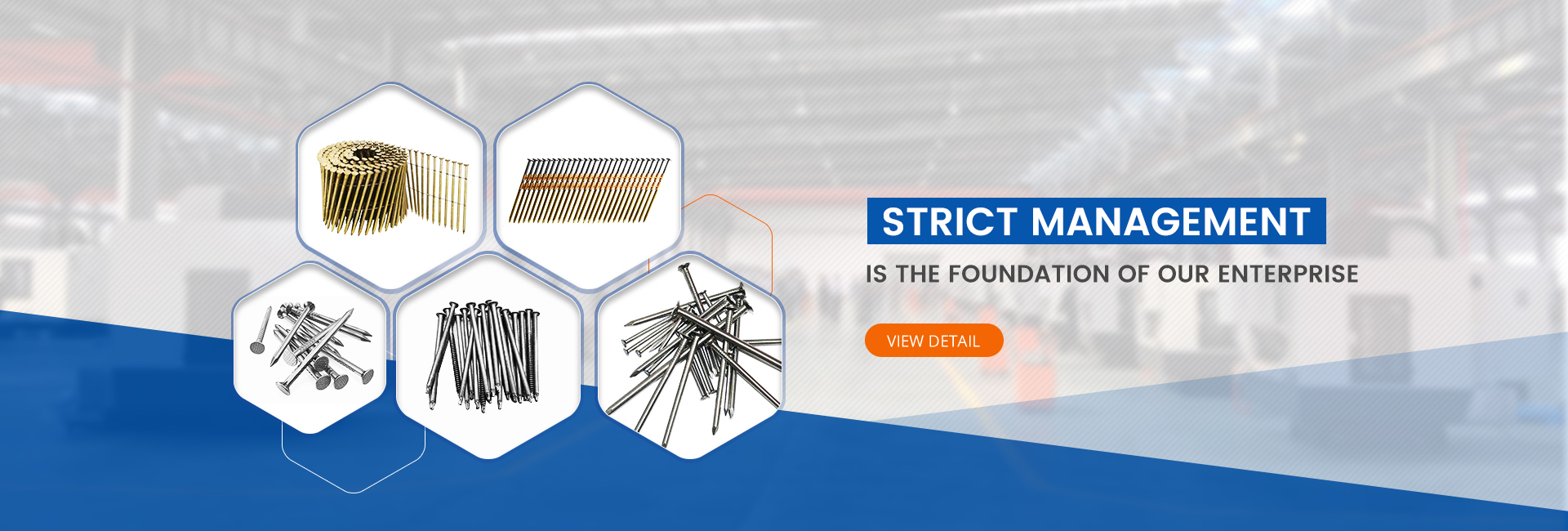
Paper Collated Nails are made by arranging individual nails at a fixed spacing and connecting them with a paper strip. They are commonly used with pneumatic nailers and are widely applied in wooden pallet manufacturing, wooden packaging, construction, furniture production, and other applications where continuous nailing is required.
At first glance, paper collated nails may look simple. It is easy to think of them as ordinary nails simply attached to a paper strip. In reality, producing a stable and reliable paper collated nail requires much more control. Nail dimensions, spacing, paper positioning, bonding strength, nail point and head formation can all affect the final performance.
The first important factor is nail consistency. Paper collated nails are normally produced for high-speed continuous applications, so the nail length, wire diameter, head dimensions and point shape need to remain consistent. Significant variation between individual nails can affect feeding and driving performance inside the nailer.
The second factor is nail spacing. The nails are not simply placed randomly on the paper strip. They need to be arranged at a controlled pitch according to the requirements of the nailer and the specific nail specification. If the spacing is inconsistent, smooth feeding may be affected.
Another detail that is often overlooked is paper strip positioning. The position of the paper strip relative to the nails needs to remain stable. Excessive deviation can affect how the collated strip runs through the nailer and may lead to feeding problems. Therefore, paper positioning is not simply an aesthetic issue; it is closely related to the nail specification, production equipment and nailer design.
Bonding strength is also critical. The adhesive needs to hold the nails firmly during production, packaging, transportation and loading into the nailer. At the same time, the nails must be able to separate properly when driven. A well-made paper collated nail therefore needs a good balance between strip integrity and clean separation during nailing.
One of the biggest advantages of paper collated nails is their suitability for high-speed continuous nailing. Instead of loading individual nails one by one, operators can use a pneumatic nailer to feed and drive the nails continuously. This can significantly improve productivity, especially in industries such as pallet and wooden packaging manufacturing, where large quantities of nails are required.
However, the quality of paper collated nails should not be judged only by their appearance. More importantly, they need to perform consistently in real applications: smooth feeding, low risk of jamming, stable penetration into wood, and sufficient strip integrity during handling.
In other words, a paper collated nail may look like a simple fastener, but its performance depends on several interconnected processes, including nail forming, nail alignment, paper strip positioning, bonding and compatibility with the nailer.
For manufacturers, quality is not simply about producing nails. It is about making sure that every strip can work reliably in the customer’s equipment.
That is perhaps the most important lesson about paper collated nails: real quality is often found in the details that are not immediately visible.
Post time: Sep-03-2026