

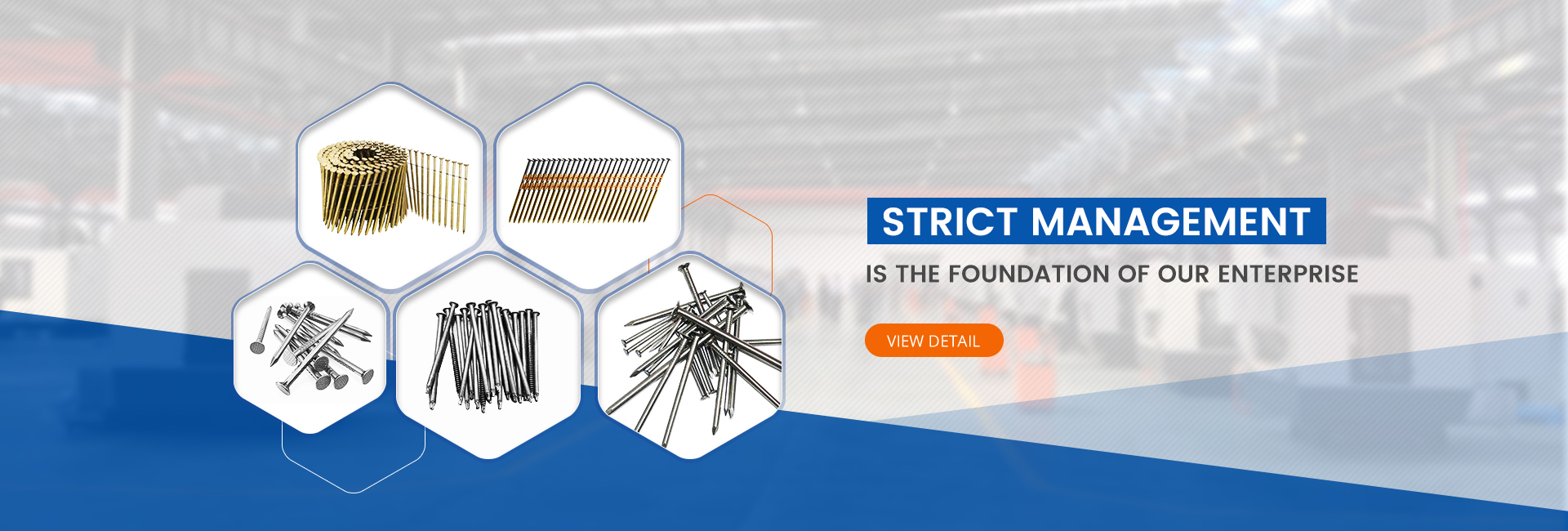
Plastic Collated Coil Nails are widely used in pallet manufacturing, wooden crates, wood packaging and other woodworking applications. Unlike loose nails, plastic collated coil nails are arranged at a fixed spacing and held together by a plastic carrier, allowing them to be fed continuously through a coil nail gun.
At first glance, a plastic coil may simply look like a group of nails arranged in a roll. In real production, however, performance depends on much more than the nails themselves.
Collation accuracy, plastic carrier quality, bonding stability and smooth feeding can all have a direct impact on production efficiency.
1. The Main Advantage Is Continuous Feeding
Pallet and wood packaging production often involves a large number of nails within a relatively short period of time. Reloading loose nails frequently would slow down the production process.
This is where plastic collated coil nails offer a practical advantage.
A coil nail gun can hold a full coil and drive nails continuously, reducing the frequency of reloading and allowing operators to maintain a more consistent working rhythm.
For manufacturers using hundreds or even thousands of coils, stable continuous feeding can make a noticeable difference to overall productivity.
2. The Plastic Carrier Is More Important Than It Looks
The plastic carrier is a key component of the coil.
It needs to be strong enough to remain stable during transportation, handling and feeding, while also having the right flexibility to move smoothly through the nail gun.
If the carrier is too brittle, it may break during transportation or use. If its dimensions or flexibility are not properly controlled, feeding performance can also be affected.
For this reason, the plastic material, thickness, forming accuracy and bonding method all need to be considered during production.
3. Collation Accuracy Affects Feeding
Plastic collated coil nails are not simply nails attached to a piece of plastic.
The angle, spacing and position of each nail need to remain consistent throughout the coil. Significant deviations can interfere with the feeding mechanism of the nail gun.
During high-speed continuous nailing, even a small inconsistency can eventually result in poor feeding, jamming or production interruptions.
That is why quality control should focus not only on nail dimensions and appearance, but also on collation accuracy and coil-to-coil consistency.
4. Different Applications Require Different Specifications
Plastic coil nails are commonly used for pallets, wooden crates, wood packaging and other timber structures.
Different applications may require different nail lengths, diameters, shank designs and surface finishes.
For pallet production, holding power, withdrawal resistance and long-term connection stability are often important considerations. For wooden crates and packaging, driving efficiency and production speed may receive more attention.
Therefore, selecting the right plastic coil nail should involve more than checking nail dimensions. The type of wood, material thickness, nail gun model and working environment should also be considered.
5. Nail Gun Compatibility Matters
Even a well-made plastic coil nail may not perform properly if it is not compatible with the nail gun.
Magazine design, feeding mechanism, collation type and applicable nail specifications can all affect the final performance.
For export orders and regular bulk purchasing, it is therefore useful to confirm the customer’s nail gun brand, model and required coil specifications in advance.
For long-term cooperation, a supplier should understand not only the nail dimensions, but also how the product is actually used.
6. Consistency from Batch to Batch
One coil feeding smoothly does not automatically mean every coil will perform the same way.
Pallet and wood packaging manufacturers may consume hundreds of coils every day. Noticeable differences between batches can directly affect their production efficiency.
The real question is:
Does this coil work smoothly? What about the next one? And the next batch?
From steel wire and nail forming to plastic carrier production, collation, coiling and packing, every stage can influence the final consistency.
Good process control should ultimately be reflected in the customer’s daily production — fewer interruptions, fewer feeding problems and more stable output.
7. Good Plastic Coil Nails Should Support Production
For professional users, plastic collated coil nails are not an isolated product. They are part of an entire nailing system.
A good plastic coil should work smoothly with the nail gun, feed consistently and maintain stable performance through repeated use.
That is why the value of plastic collated coil nails is not simply about how many nails are contained in one coil.
It is about whether the product can help reduce downtime, minimize feeding problems and keep production moving at a consistent pace.
Conclusion
Plastic Collated Coil Nails may look simple, but they connect several important elements: the nail, the plastic carrier, the nail gun and the production process.
For pallet, crate and wood packaging manufacturers, a valuable fastening product is not simply one that meets the basic specifications. It should perform reliably in real production.
From nail dimensions to carrier strength, from collation accuracy to coil-to-coil consistency, these details ultimately determine how the product performs on the production floor.
Good fasteners should not become a problem in production. They should make production run more smoothly.
Post time: Sep-30-2026