

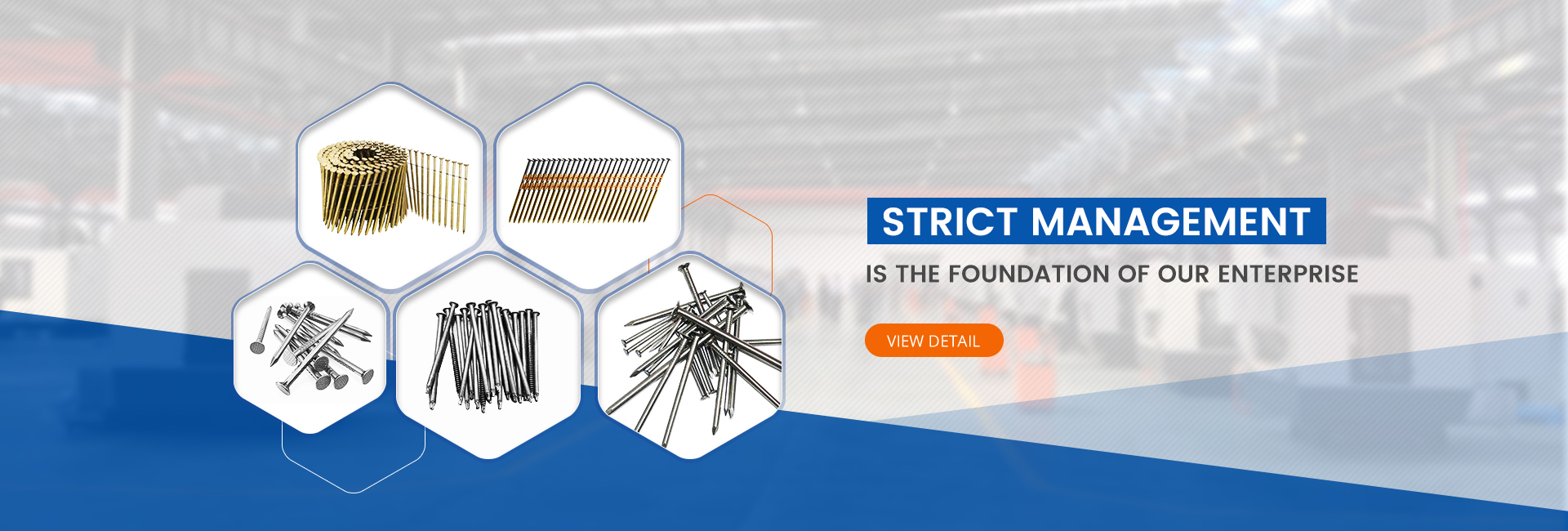
When talking about coil nails, many people focus first on diameter, length, shank type and surface finish. These specifications are important, but they are only the starting point.
In actual production, the consistency of a coil nail depends on many small details. A nail may look acceptable when taken individually, but if the wire diameter, thread, welding point or coil pitch is inconsistent, problems can appear when the nails are loaded into a nail gun or used continuously on a production line.
Here are several key points that deserve attention during coil nail manufacturing.
1. Wire diameter is the foundation
The actual wire diameter directly affects the weight, strength and performance of the finished nail.
For example, a coil nail specified as 2.5 mm should not simply be judged by appearance. The wire diameter needs to be controlled consistently throughout production. Even a small difference can affect the weight per coil and the customer’s actual consumption.
This is especially important for pallet nails, where customers often compare nails by weight, quantity and driving performance.
2. Nail length needs to be consistent
Nail length is another basic but critical parameter.
If the cutting length fluctuates too much, the finished nails may not only fail to meet the specification, but can also affect penetration depth and holding performance.
For high-volume applications such as pallet manufacturing, consistency is more important than having a few individual nails that simply meet the specification.
3. Thread rolling needs sufficient and consistent length
For screw shank or ring shank coil nails, the threaded or ringed section is particularly important.
The thread should not be too short, and the transition area near the welding wire should also be properly formed where required by the specification.
An inconsistent threaded area can change the nail’s holding performance and may also affect the customer’s weight comparison.
This is one of those details that may be easy to overlook during visual inspection but becomes obvious when the customer actually uses the nails.
4. Welding is not just about making the coil hold together
The welding point is one of the most important parts of a coil nail.
The welding needs to provide enough strength to keep the nails connected during feeding, while avoiding excessive welding that may affect the nail gun’s operation.
The position, strength and consistency of the weld all matter.
If the welding point is too weak, the coil may break during transportation or feeding. If it is too large or irregular, it may interfere with smooth feeding through the nail gun.
A good coil nail should therefore achieve a balance between secure welding and smooth driving performance.
5. Coil pitch and alignment should be stable
After the nails are welded together, they need to be formed into a consistent coil.
The coil pitch, nail angle and alignment should remain stable throughout the coil.
If the pitch changes significantly, the coil may not feed smoothly through the nail gun. This can lead to feeding problems, misfires or interruptions during continuous operation.
For customers using automatic pallet nailing equipment, stable feeding is often more important than simply having good-looking individual nails.
6. Nail point geometry affects driving performance
The nail point is another area that deserves attention.
Different applications may require different point designs, such as diamond point, blunt point or skew point.
The point should be consistent in shape and length. An irregular point can increase the risk of wood splitting, deflection or inconsistent penetration.
For pallet applications, the correct point design should be selected according to the wood species, nail specification and customer’s nailing equipment.
7. Surface treatment should be controlled by specification
Galvanizing is not simply a question of whether the nail looks shiny.
The coating thickness, adhesion and uniformity are much more important.
Different customers may require different galvanizing levels, such as standard electro-galvanized or higher coating requirements. Therefore, the coating specification should be confirmed before production rather than judged only by appearance.
A bright surface does not automatically mean a thicker or better coating.
8. Packaging also affects the final product
Even when the nails themselves are produced correctly, poor packaging can create problems before the customer receives them.
Coils should be packed securely enough to prevent deformation, loose nails or damaged welding points during transportation.
Carton strength, coil arrangement, pallet loading and moisture protection should all be considered, especially for long-distance sea shipments.
Quality is built into the process
The most important lesson is that coil nail quality cannot be created by final inspection alone.
It has to be built into every stage — wire preparation, nail making, thread rolling, welding, coiling, surface treatment and packing.
A qualified coil nail should not only meet the drawing on paper. It should also perform consistently in the customer’s nail gun and production environment.
For us, the goal is not simply to make a coil of nails that looks good.
The real goal is to make a coil nail that feeds smoothly, drives consistently, holds reliably and performs the same way coil after coil.
That is where manufacturing quality really shows.
Post time: Sep-15-2026