

In today’s pallet manufacturing, wooden packaging, crate production, and logistics industries, productivity and product reliability have become more important than ever. As a key fastening solution for automated nailing applications, Plastic Sheet Coil Nails are widely used for their high loading capacity, continuous operation capability, and excellent installation efficiency.
Compared with loose nails, plastic sheet coil nails are connected by durable plastic sheets and assembled into coils, allowing operators to use coil nailers for fast and continuous fastening. This significantly reduces reloading time and improves overall productivity.
What Are Plastic Sheet Coil Nails?
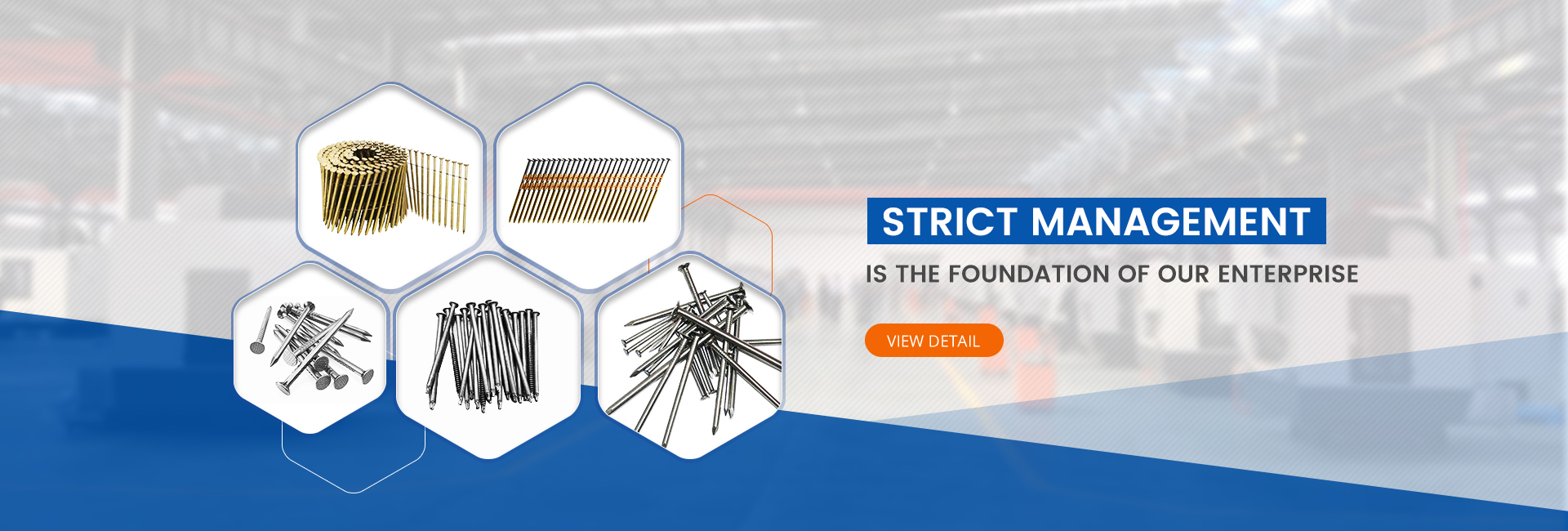
Plastic sheet coil nails are nails collated together with plastic strips and wound into coils for use in pneumatic coil nailers.
Common sizes include:
- 2.1×25mm
- 2.1×35mm
- 2.3×50mm
- 2.5×57mm
- 2.5×64mm
- 2.5×70mm
- 2.8×75mm
- 3.1×90mm
Depending on application requirements, they are available in:
- Smooth Shank
- Ring Shank
- Screw Shank
Surface finishes include:
- Electro Galvanized
- Hot Dip Galvanized
- Mechanical Galvanized
- Stainless Steel
These options provide suitable solutions for indoor, outdoor, and high-humidity environments.
Why Are More Pallet Manufacturers Choosing Plastic Sheet Coil Nails?
1. Higher Productivity
Production speed directly impacts profitability in pallet manufacturing.
A single coil typically contains 200–300 nails, allowing operators to work longer without frequent reloading.
This advantage becomes even more significant in automated pallet production lines where continuous operation is essential.
2. Stronger Holding Power
Ring shank and screw shank coil nails offer superior withdrawal resistance.
Pallets are constantly exposed to:
- Forklift handling
- Heavy stacking loads
- Transportation vibration
- Repeated loading and unloading
A stronger fastening system helps maintain pallet integrity and reduces structural failures.
3. Lower Overall Production Costs
Although the cost difference per nail may be relatively small, the overall savings generated through improved productivity, reduced labor costs, and fewer repairs can be substantial.
Many pallet manufacturers recognize that production efficiency often has a greater impact on profitability than nail price alone.
Global Market Trends
Demand for high-quality plastic sheet coil nails continues to grow worldwide, particularly in markets such as:
- United Kingdom
- Spain
- Netherlands
- Germany
- Poland
- South Africa
- Mexico
As automation becomes increasingly common, customers are paying closer attention to product consistency and performance.
Important quality requirements include:
- Consistent nail dimensions
- Secure collation strength
- Uniform coil formation
- Excellent corrosion resistance
- Stable coil diameter
These factors directly affect nailer performance and production efficiency.
As a result, buyers are placing greater emphasis on supplier reliability and quality control rather than focusing solely on pricing.
How to Evaluate the Quality of Plastic Sheet Coil Nails
High-quality coil nails generally feature:
Consistent Nail Dimensions
Accurate diameter and length tolerances ensure smooth feeding.
Uniform Coil Formation
Neatly wound coils help prevent jamming during operation.
Strong Plastic Collation
The plastic strips should remain secure during transportation and handling.
Reliable Corrosion Protection
Uniform coatings improve durability and service life.
Sharp Diamond Points
Sharp points allow easier penetration and help reduce wood splitting.
These details may seem small, but they significantly influence real-world performance.
Conclusion
Although plastic sheet coil nails represent only a small component in pallet manufacturing, they play a critical role in determining productivity, product quality, and customer satisfaction.
As global logistics and automated manufacturing continue to expand, the importance of reliable, high-quality coil nails will only increase.
For pallet manufacturers and packaging companies, choosing the right coil nail supplier is not simply a purchasing decision—it is an investment in efficiency, reliability, and long-term competitiveness.
Post time: Jun-01-2026